
Pessimism & Skepticism
What is the meaning of this Emotion:
It is the belief that both good and bad things will happen, but my experience is mostly bad things.
When have I felt this Emotion?
I have felt this emotion when I expect the worst, and assume decline or failure. I avoid risk due to expected failure.
What does this Emotion Feel Like?
Emotionally weighted, leaning toward despair, disengagement or defeat. We tend to act with little energy or commitment
Example/Scenario 1(Read)
You are currently working in a position which is not aligned with your strengths or passion and you feel you need a change. When a position you would really like becomes available, rather than applying for the position, your self-talk convinces you that you would be overlooked and rejected so why bother. This approach protected you from the pain of hope and limits your possibilities based upon your fears or previous disappointments.
Example/Scenario 2(Read)
The meeting started with Sarah presenting her innovative idea for a new project, complete with detailed plans and potential benefits. As she finished, Mark immediately interjected, “That’s an interesting thought, but it’ll never work. We tried something similar years ago and it failed spectacularly. Plus, management will never approve the budget, and even if they did, the market isn’t ready for it. We’re just setting ourselves up for another disappointment.” He then slumped back in his chair, a look of resigned certainty on his face, having already determined the project’s inevitable failure before any discussion could even begin.
Scenario 1 Audio
| Link to audio file |  |
Scenario 2 Audio
| Link to audio file | |
How does this feel in my Body?
| Body Urge: | Withdraw, disengage, avoid risk |
| Stomach Sensation | Heaviness, a “sinking” feeling |
| Muscle Tension | Slackness or low energy, sometimes clenched jaw |
Levels of Intensity.
| Mild | You’re planning a picnic, but you glance at the cloudy sky and say, “It’s probably going to rain.” |
| Moderate | After several job rejections, you begin to believe none of your applications will lead anywhere. |
| Intense | You look at the state of the world or your life and conclude that improvement is impossible, that everything will get worse no matter what. |
What Emotion we confuse it with.
| Anxiety, Hopelessness | Hopelessness is a strong feeling that things will not get better, or that there’s no solution to a problem and usually a result from a pessimistic mindset. |
How Can We Recognize it in Others?
They consistently focus on the potential downsides, flaws, or worst-case scenarios, even in seemingly positive situations. They might immediately list all the reasons why something won’t work, rather than exploring possibilities.
1st Question to Consider
What underlying beliefs or past experiences might be consistently shaping a person’s expectation of negative outcomes?
2nd Question to Consider
How does this pessimistic outlook consistently influence their decision-making, motivation, and emotional responses, particularly when faced with challenges or new opportunities?
Quote:
A pessimist is one who makes difficulties of his opportunities and opportunities of his difficulties.”
– Reginald B. Mansell
Analogy/Metaphor
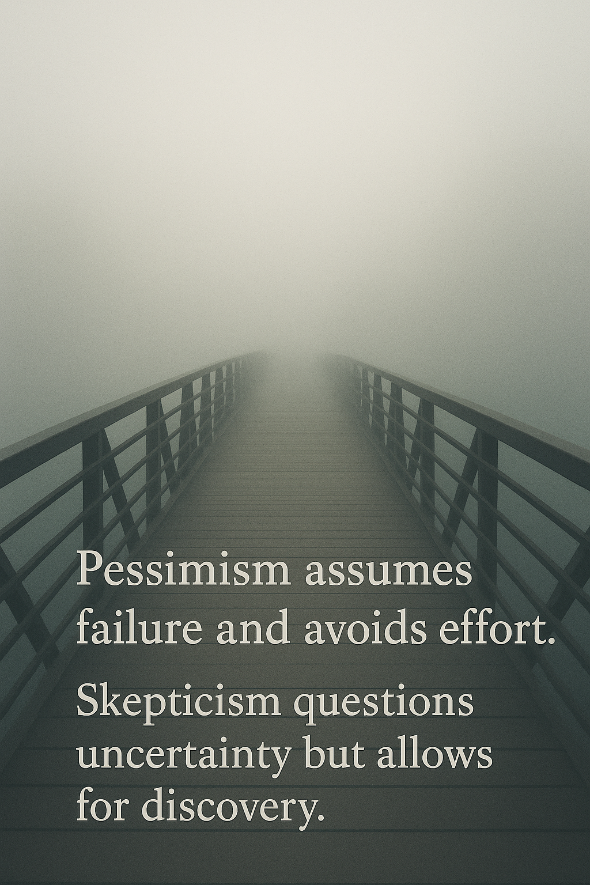

What is the meaning of this Emotion:
You are questioning a belief or whether to believe something new.
When have I felt this Emotion?
I have felt this emotion when I suspend belief until proof is provided. I will weigh the risk and seek evidence before committing.
What does this Emotion Feel Like?
Mentally active, intellectually cautious, protective, curious and open if convinced.
Example/Scenario 1(Read)
You saw an ad for a training program on Facebook. After clicking the link and listening to the pitch, you felt that something was off, so you do some more research about reviews from third parties and find that there are several people who have complained and are not getting their refunds. Originally, you did not dismiss the program, but after careful research you are not as interested anymore.
Example/Scenario 2(Read)
During the team brainstorming session, Liam excitedly proposed a new, untested marketing strategy, claiming it would double their online engagement within a month. Maria listened quietly, a thoughtful, unblinking expression on her face. When he finished, she slowly said, “That sounds very promising, Liam. Could you walk us through the data that supports such a significant increase? What pilot programs or research have shown similar results with this approach, especially in our specific market segment? I’m interested, but I’d like to understand the evidence backing those projections before we commit.” Her tone was curious, not dismissive, but clearly demanding verifiable proof.
Scenario 1 Audio
| Link to audio file | |
Scenario 2 Audio
| Link to audio file | |
How does this feel in my Body?
| Body Urge: | Pause, question, investigate |
| Stomach Sensation | Neutral or a slight tension from guardedness |
| Muscle Tension | Subtle tension in jaw, forehead, or arms |
Levels of Intensity.
| Mild | A friend claims they’ve found the best pizza place in town. You raise an eyebrow playfully. |
| Moderate | A company promises an “easy, guaranteed” way to earn money quickly. You research the offer and read the fine print. |
| Intense | A politician makes sweeping promises that contradict past behavior. You dismiss their speech entirely and feel distrustful of the entire system. |
What Emotion we confuse it with.
| Cynicism | Belief that people are motivated purely by self-interest; distrust of sincerity or integrity. We do not believe in the good intentions of others. |
How Can We Recognize it in Others?
We can recognize skepticism in others through their tendency to question claims, ask for evidence, and express doubt until presented with sufficient proof. They will often respond to statements with “How do you know that?” or “What’s the evidence for that claim?” rather than immediate acceptance.
1st Question to Consider
What specific criteria or level of evidence does someone require before accepting a claim as credible, and where do they draw the line between healthy doubt and outright dismissal?
2nd Question to Consider
Does skepticism primarily serve to critically evaluate information for truth, or does it stem from a general distrust, cynicism, or resistance to new ideas that hinders open-minded inquiry?
Quote:
“The good thing about science is that it’s true whether or not you believe in it.”
– Neil deGrasse Tyson
This quote, while not explicitly using the word “skepticism,” embodies the scientific skeptical approach: the truth is based on evidence and verifiable facts, not on personal belief or opinion, which is the core of healthy skepticism.
Inspiration

You set it aside, untouched—not because you know what’s inside, but because you believe the worst.
————–
To reduce the impact of others’ negativity, it’s helpful to limit interactions with those who consistently complain, or gently steer conversations towards more constructive subjects. Actively seeking out the company of positive, solution-oriented individuals can offer a crucial balance, strengthening a more optimistic and resilient outlook. Furthermore, by regularly practicing gratitude, fostering self-awareness, and developing healthy ways to process our frustrations, we can progressively reprogram our minds to prioritize finding solutions over getting stuck in problems.