
Resources
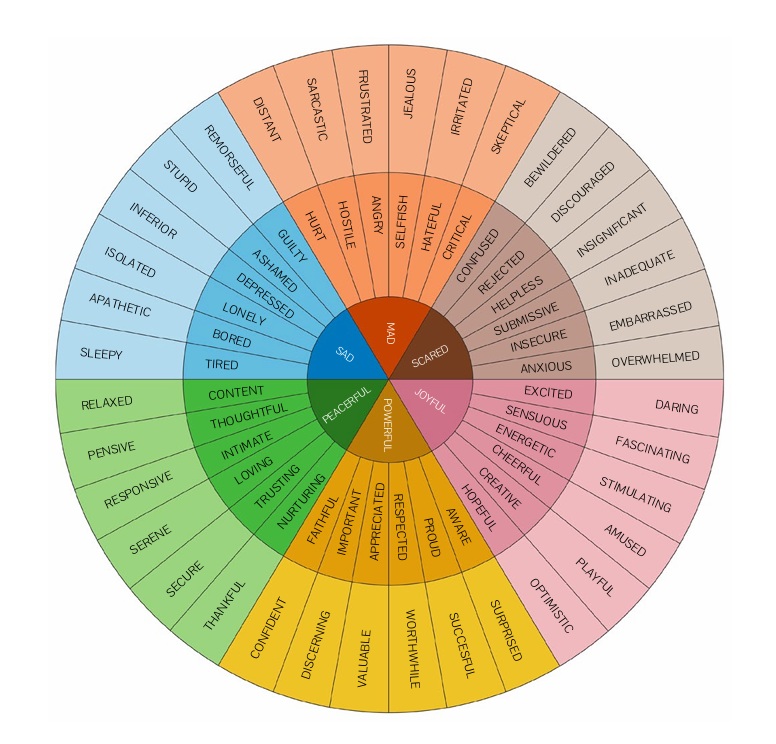
The Feeling Wheel
The ability to identify one’s own emotions and those of others is a skill that is related to emotional intelligence. People differ in the extent to which they can identify the degree of specificity of their emotional experiences. People with high differentiation can
communicate more detailed emotional experiences. They are better able to distinguish the intensity of emotions and use a greater emotional vocabulary. In contrast, people with a low differentiation use only a few general emotional states and often struggle to
communicate their feelings in specific terms.
It is important to be able to label experiences with a high degree of specificity (i.e., beingable to make fine-grained distinctions). Moreover, preliminary evidence suggests that training individuals to expand their emotional vocabulary and use it flexibly can help them regulate their emotions more effectively. Thus, this tool was designed to help you expand your emotional vocabulary.
Advice
Note that the feelings depicted in the Feeling Wheel (see Fig. 1) are not a complete overview of all possible feelings and emotions. Rather, they serve as a guide and starting point that may help you describe your experiences.
Although this exercise can be used in many ways, using it when the emotion is being experienced is preferable because the immediate approach circumvents memory distortions or (inaccurate) cognitive representations of the experiences.
It can be useful for you to carry a hardcopy of the Feeling Wheel (see Fig. 1) or store a digital image on your phone so that it can be accessed at any given time.
Note that it is possible to experience different emotions at the same time. The emotions and feelings in the wheel are not mutually exclusive but exist in many combinations, even positive and negative at the same time.
“You cannot heal what you cannot feel.” This tool can also be used to increase selfcompassion. To develop self-compassion, it is important to pay attention to the experiences that are present to take appropriate, compassionate action. For instance, if you realized that you are experiencing shame, the kind inner voice that can be cultivated could focus on the experience of this specific emotion (“It is ok to experience shame: I am a
human being and I make mistakes.” “This experience of shame tells me that I can learn from this experience so that I can do it differently next time.”).
Note that the uncomfortable feelings in the inner band of the wheel are located on the exact opposite side of the wheel compared to the comfortable feelings. For instance, joy is the comfortable core feeling opposite of sadness. Although you may use this information to gain insight into the comfortable emotions or feelings that are least present and may need further attention, this feature of the wheel should not be used to replace or avoid emotions. For instance, when you experience sadness, it is advisable to allow the sadness to be present rather than to try to replace it with joyful thoughts.
Instructions
Please look at the wheel on the final page. The wheel organizes 72 feelings into a pie chart and categorizes them into these six groups: sad, mad, scared, joyful, powerful, and peaceful.
The wheel can be useful in identifying the specific feelings and emotions you are experiencing at any given moment so that they can be addressed and resolved. For instance, if you experience a generally sad feeling, you can use the outer bands of the wheel to figure out what specific kind of sadness you might feel. For example, maybe what you are experiencing is feeling ignored. Note that the reverse can also happen. For instance, by using the wheel, you may realize that feeling inadequate may be rooted in rejection or fear at a deeper level.
Direct Reflection at the Moment
You can use the wheel to explore the emotions you are feeling at any given moment during the day. For instance, after a nice conversation with someone, you notice a general feeling of joy. Using the wheel, you may ask yourself, what kind of joy am I experiencing right now? Can this
feeling best be described as excitement, creativity, cheerfulness, etc.?
Daily Reflection
Take a moment to contemplate and look at the wheel. What did you experience today? Maybe, at some point during the day, you felt guilty. Once you find “guilty” on the middle band of the wheel, you can see that the associated core feeling (nearer the center) is “sad,” and the more specific, nuanced feeling (on the outer band) is “remorseful.”
Long Term Reflection
The wheel can also be used to explore deeper and longer-term emotions that may be affecting you. For instance, maybe you have been feeling scared over the last several months since you lost your job. By going to the core feeling “scared” on the inner band of the wheel, you can look at the two outer bands for feelings associated with “scared” to try to unveil the more detailed, nuanced emotions you are experiencing. You might conclude that you are more specifically feeling rejected and insecure. This can be an important insight that can help you take specific actions towards the
desired goal.
Note that the feelings depicted in the Feeling Wheel (see Fig. 1) are not a complete overview of all possible feelings and emotions. Rather, they serve as a guide and starting point that may help you describe your experiences.
Although this exercise can be used in many ways, using it when the emotion is being experienced is preferable because the immediate approach circumvents memory distortions or (inaccurate) cognitive representations of the experiences.
It can be useful for you to carry a hardcopy of the Feeling Wheel (see Fig. 1) or store a digital image on your phone so that it can be accessed at any given time.
Note that it is possible to experience different emotions at the same time. The emotions and feelings in the wheel are not mutually exclusive but exist in many combinations, even positive and negative at the same time.
“You cannot heal what you cannot feel.” This tool can also be used to increase selfcompassion. To develop self-compassion, it is important to pay attention to the experiences that are present to take appropriate, compassionate action. For instance, if you realized that you are experiencing shame, the kind inner voice that can be cultivated could focus on the experience of this specific emotion (“It is ok to experience shame: I am a human being and I make mistakes.” “This experience of shame tells me that I can learn from this experience so that I can do it differently next time.”).
Note that the uncomfortable feelings in the inner band of the wheel are located on the exact opposite side of the wheel compared to the comfortable feelings. For instance, joy is the comfortable core feeling opposite of sadness. Although you may use this information to gain insight into the comfortable emotions or feelings that are least present and may need further attention, this feature of the wheel should not be used to replace or avoid emotions. For instance, when you experience sadness, it is advisable to allow the sadness to be present rather than to try to replace it with joyful thoughts.
Please look at the wheel on the final page. The wheel organizes 72 feelings into a pie chart and categorizes them into these six groups: sad, mad, scared, joyful, powerful, and peaceful.
The wheel can be useful in identifying the specific feelings and emotions you are experiencing at any given moment so that they can be addressed and resolved. For instance, if you experience a generally sad feeling, you can use the outer bands of the wheel to figure out what specific kind of sadness you might feel. For example, maybe what you are experiencing is feeling ignored. Note that the reverse can also happen. For instance, by using the wheel, you may realize that feeling inadequate may be rooted in rejection or fear at a deeper level.
You can use the wheel to explore the emotions you are feeling at any given moment during the day. For instance, after a nice conversation with someone, you notice a general feeling of joy. Using the wheel, you may ask yourself, what kind of joy am I experiencing right now? Can this
Take a moment to contemplate and look at the wheel. What did you experience today? Maybe, at some point during the day, you felt guilty. Once you find “guilty” on the middle band of the wheel, you can see that the associated core feeling (nearer the center) is “sad,” and the more specific, nuanced feeling (on the outer band) is “remorseful.”
The wheel can also be used to explore deeper and longer-term emotions that may be affecting you. For instance, maybe you have been feeling scared over the last several months since you lost your job. By going to the core feeling “scared” on the inner band of the wheel, you can look at the two outer bands for feelings associated with “scared” to try to unveil the more detailed, nuanced emotions you are experiencing. You might conclude that you are more specifically feeling rejected and insecure. This can be an important insight that can help you take specific actions towards the desired goal.