Fear & Anxiety
What is the meaning of this Emotion:
That we may be harmed by something or something specific such as falling off our bike and breaking a bone.
When have I felt this Emotion?
I feel this emotion when I am paying attention to my instincts and intuition that something is not good for me or unsafe. My intuition is letting me know I am facing a possible hazard. I have felt this emotion when I am responding to a known, immediate threat, and I am in survival mode.
What does this Emotion Feel Like?
We run away or freeze in order to avoid danger.
Example/Scenario 1(Read)
Driving in Unfamiliar, Worsening Conditions:
Imagine you’re driving on a familiar highway, but as you enter a forested stretch, the sky suddenly darkens, hinting at an unexpected storm. A healthy, moderate fear response kicks in, sharpening your senses. Your grip on the steering wheel subtly tightens, your eyes scan the road more intently, and your focus shifts entirely to safe navigation. You’re not panicking, but a helpful jolt of alertness makes you proactively reduce your speed, turn on your headlights, and increase your following distance, all without a second thought.
This mild fear is incredibly beneficial because it’s proportionate to the potential threat and directly leads to protective actions. It’s an adaptive, temporary state that ensures you take necessary precautions, like slowing down to prevent hydroplaning or seeing other cars more clearly in dimming light. Once you’ve safely passed through the rough weather, or reached your destination, this heightened state of awareness naturally subsides, leaving you safer and more secure for having heeded its warning.
Example/Scenario 2(Read)
You are walking alone at dusk:
Imagine you’re walking alone at dusk through a quiet, tree-lined park you frequent, when you suddenly hear a rustling in a dense patch of bushes nearby. A healthy, moderate fear response would cause your head to snap towards the sound, your body to become instantly more alert, and your heart rate to subtly quicken. You’re not screaming or running wildly, but your senses are on high alert, assessing if the sound is just a squirrel, or something that warrants more caution.
This instinctive jolt of fear is a protective mechanism. It prompts you to immediately scan your surroundings, perhaps instinctively change your walking pace, or even subtly adjust your route to create more distance from the unknown. Once you determine it’s just a small animal, or you pass the area safely, the mild tension quickly dissipates, having served its purpose of momentarily heightening your awareness and preparing you to react if a genuine threat had emerged.
Scenario 1 Audio
| Link to audio file |  |
Scenario 2 Audio
| Link to audio file | |
How does this feel in my Body?
| Body Urge: | Run, hide, fight or escape |
| Stomach Sensation | Nausea or a dropping sensation in the gut |
| Muscle Tension | Full-body rigidity with a readiness to act |
Levels of Intensity.
| Mild | You hear a strange noise downstairs at night but quickly realize it’s just the wind. |
| Moderate | You’re about to give a public speech and your mind starts racing with what could go wrong. |
| Intense | You’re walking alone at night and hear footsteps rapidly approaching from behind. |
What Emotion we confuse it with.
| Anxiety | We believe that we may become harmed but are not sure of the cause. |
| Anger | Anger typically pushes one towards the perceived threat, whereas fear often prompts withdrawal. |
| Panic | Panic provokes us to act immediately, but without direction. |
How Can We Recognize it in Others?
They show resistance to taking action, over vigilant or immobilized.
1st Question to Consider
What in your life is more important than your fear? Is that an easy question to answer- – why?
2nd Question to Consider
When is Fear harmful? When is Fear healthy?
Quote:
Your fear is the edge of your growth. Go there!
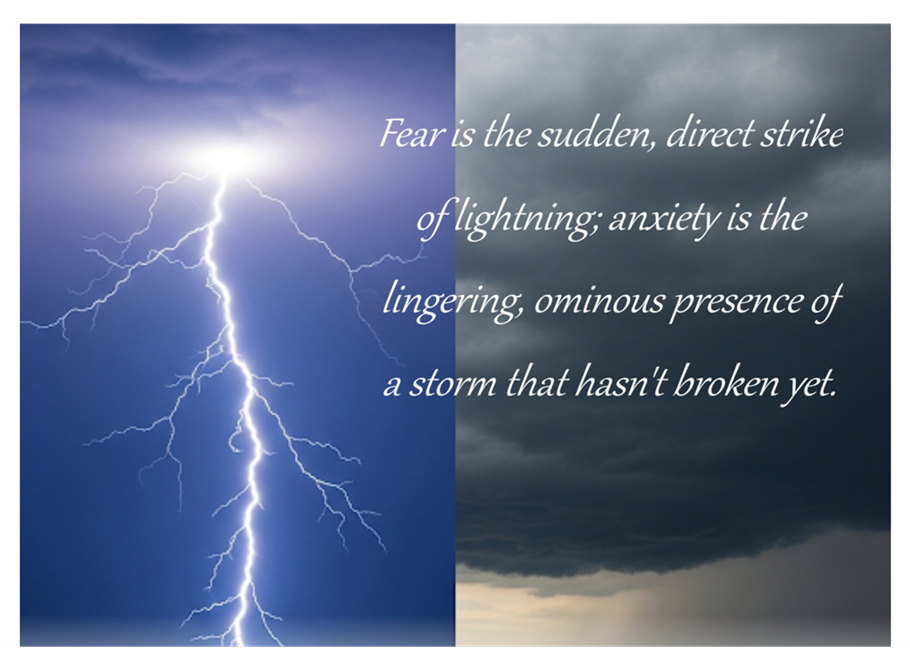
Analogy/Metaphor
What is the meaning of this Emotion:
We believe that we will experience harm but we are unsure of the source.
When have I felt this Emotion?
I have felt this emotion when I am uncertain but I anticipate something might happen soon. I feel this emotion when I can’t predict what might be coming and I want to prepare for every possible outcome. My mind starts running possible scenarios between now and the unknown and my nervous system is flooded.
What does this Emotion Feel Like?
We worry and think in a circular pattern about the danger and outcome we believe might occur.
Example/Scenario 1(Read)
Preparing for a Significant Work Presentation : You have a crucial presentation coming up next week to a new client that could significantly impact your company’s future. You’ve prepared diligently, but the importance of the presentation triggers a moderate level of anxiety. This isn’t a debilitating panic, but rather a persistent feeling of being “on edge” or “keyed up” about the upcoming event. You find yourself thinking about it frequently throughout the day, even when you’re not directly working on it.
This healthy anxiety manifests in several ways: you might find it slightly harder to relax in the evenings, your sleep might be a little less sound than usual, and you may experience a persistent, low-level buzz of nervous energy. However, this anxiety is productive. It drives you to meticulously review your slides, anticipate potential questions, rehearse your delivery repeatedly, and even consider backup plans for technical glitches. It ensures you’re thoroughly prepared, sharp, and focused when the actual presentation day arrives, ultimately enhancing your performance and increasing the likelihood of a positive outcome.
Example/Scenario 2(Read)
Over-Analyzing a Minor Social Interaction:
Imagine you had a casual conversation with a new colleague at the office water cooler. It was brief and seemingly unremarkable. However, a moderately unhealthy anxiety response might cause you to spend the rest of the day, or even several days, obsessively replaying that interaction in your mind.
You might continually analyze every word you said, every glance from your colleague, and every pause in the conversation. You’d find yourself catastrophizing, imagining worst-case scenarios: “Did I sound stupid?” “Did I interrupt them?” “They probably think I’m awkward and now everyone will avoid me.” This internal loop isn’t just a quick review; it’s a persistent, intrusive mental exercise that drains your energy. It might lead to physical manifestations like a constant knot in your stomach, difficulty concentrating on work, or even mild insomnia as your mind races at night. Instead of moving on, this anxiety traps you in a cycle of self-doubt and overthinking, disproportionate to the actual event, and prevents you from fully engaging with your current tasks or other positive interactions.
Scenario 1 Audio
| Link to audio file | |
Scenario 2 Audio
| Link to audio file | |
How does this feel in my Body?
| Body Urge: | Avoid, over-prepare, fidgety or control |
| Stomach Sensation | Churning, knots, butterflies and unease |
| Muscle Tension | Ongoing tension in the shoulders, jaw, neck or chest. |
Levels of Intensity.
| Mild | You’re waiting for a text back after sending a vulnerable message. |
| Moderate | You have an important deadline approaching, and you feel behind. |
| Intense | You’re about to walk into a situation where you feel completely unprepared—like a high-stakes interview or confrontation—and your thoughts spiral. |
What Emotion we confuse it with.
| Fear | I will be harmed by something or someone specific. |
| Excitement | Excitement feels like positive anticipation for a desirable outcome versus anticipation of a negative outcome. |
| Worry | Worry is not a true emotion, but is considered a component of Anxiety.
Shame, Guilt and Embarrassment can sometimes manifest as anxiety. |
How Can We Recognize it in Others?
The subject of their thoughts flows over in everything they say or do. They act nervous and express unreasonable reactions.
1st Question to Consider
When is Anxiety harmful? When is Anxiety Healthy?
2nd Question to Consider
Remember to take care of yourself. You can’t pour from an empty cup. What do you think this means?
Quote:
Anxiety does not empty tomorrow of its troubles, but it empties it of its strength. –George Seaton Bowes
Inspiration
Anxiety can be healthy when we monitor our anxiety, and manage it. It is important to not become overwhelmed by things we cannot control.
________
Comment on Overwhelming: This is not an emotion; it is called a condition and a valid human experience. Feeling overwhelmed means being so consumed by thoughts, emotions, or responsibilities that you feel unable to cope. It can also mean being overcome by a strong emotion such as panic, fear, exhaustion or anxiety. When things feel overwhelming remember… one thought at a time, one task at a time, one day at a time. Just Breathe